Wallace S
Mariners' Museum, Uncurated Search Results
Type: Skipjack
Year: 1890
Builder:
Location: Crisfield
These records are found in the online catalog of The Mariners’ Museum and Park in Newport News, Virginia. Uncurated search results are presented to give researchers and interested readers an idea of whether the museum’s archives contain information about this vessel and whether it may be worthwhile to visit the museum’s catalog search page for further investigation. Uncurated results may be inaccurate or incomplete.
Search mode: Exact Name. Search phrase(s): "Wallace S". Results returned: 12. Results displayed in this table: 12.
Use these buttons to send uncurated search results to your own app or text document for further research. First, check the box for any row, or click "Select All" then uncheck any rows. Then click "Show Selections". You can then copy your selections from the text box and past them into your app.
| Fetch? | Row ID | Media | Date | Vessel | Place | Related Places | Inscription/Marks | Subject | Notes | Archive Number |
|---|---|---|---|---|---|---|---|---|---|---|
| 1 | No image URL. | Virginia (Ironclad : 1862). | Norfolk (Va.)–History–Civil War, 1861-1865.; Camp Blanchard (La).; United States–History–Civil War, 1861-1865–Personal narratives, Confederate. | Wallace, S. S. | LB107447 | |||||
| 2 | No image URL. | Virginia (Ironclad : 1862). | Norfolk (Va.)–History–Civil War, 1861-1865.; Camp Blanchard (La).; United States–History–Civil War, 1861-1865–Personal narratives, Confederate. | This is a typescript of Wallace's letter. The sketches mentioned in the letter are not included in his correspondence. In his letter, he refers to the Virginia as the Merrimac. | LB104734 | |||||
| 3 | No image URL. | The navy - a national investment. | LB62822 | |||||||
| 4 | No image URL. | map. | LB48156 | |||||||
| 5 | 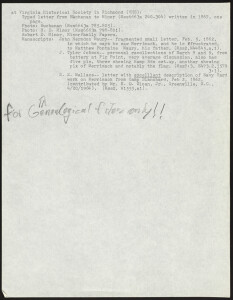 | After 1978-Before 1992 | Gosport Navy Yard (U.S.).; Virginia (Ironclad : 1862). | Genealogy–Archival resources. | One page typed list of genealogical records at the Virginia Historical Society. Included are references to materials on Franklin Buchanan and Robert D. Minor, as well as manuscripts from John Herndon Maury, J. Tyler Jonson, and S. S. Wallace. The list includes call numbers for the Virginia Historical Society. Title devised by Library staff. | MS0164.001/07-008.20#43 | ||||
| 6 | No image URL. | Discussion included. | LB63093 | |||||||
| 7 | No image URL. | Ward (Destroyer : DD-139). | WARD - man and ship. | LB64399 | ||||||
| 8 | No image URL. | Discussion included. | LB62824 | |||||||
| 9 | No image URL. | Oregon (Battleship : No. 3). | Battleships–United States. | Old OREGON gets a new home. | LB77025 | |||||
| 10 | No image URL. | United States. Navy. Yangtze Patrol. | Our Chinese navy. | LB66160 | ||||||
| 11 | No image URL. | United States. Navy–Officers. | Income tax. | Swallowing the anchor for taxes. | LB63310 | |||||
| 12 | 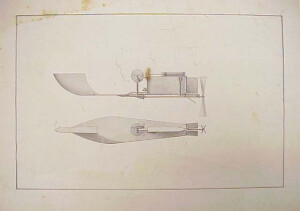 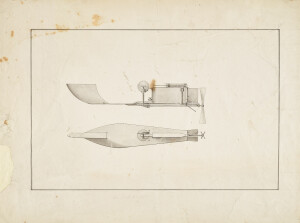 | SHORT DESCRIPTION: Ink and wash drawing of a cross section and elevation view of a one-man semi-submersible boat. The drawing shows the proposed method of propulsion, the propeller and rudder. NOTES: Wallace Hutcheon states on page 68 of 'Robert Fulton, Pioneer of Undersea Warfare': Robert Fulton's technical concept of the submarine had changed since the Brest operations of 1801. At some point during his first months in England, he made a drawing of a small submarine which he named the "Messenger." This submarine was to be nine feet long, thus large enough for one man only, but it was never constructed. NOTES: [From Sotheby’s catalog entry for lot 44 10/26/1983] Fulton's Nautilus was a "diving boat" equipped with a compressed air tank that allowed it to remain underwater for four and a half hours. Fulton constructed the vessel at LeHavre in the winter of 1800-1801, and he descended to a depth of twenty-five feet in the boat. The Nautilus's trials before French officials were so successful that Fulton was encouraged to proceed with his experiments and even took the Nautilus on coastal reconnoitering voyages against the British that summer. The Messenger is not known to have progressed beyond its planning stages: the boat was to be operated by a single man who guided the boat by foot-operated rudder and diving planes. [From Sotheby’s catalog entry 10/26/1983] Robert Fulton’s Designs for Naval and Submarine Warfare from the Solomon Alofsen Collection at the New Jersey Historical Society. The drawings offered here are the designs of Robert Fulton (1765-1815) for his experiments with submarine boats and naval armaments. While in France, Fulton built an operational submarine vessel, the Nautilus, which he tested personally in 1800 and 1801. At the same time, he began designs for submarine bombs and mines. In 1804, the British government persuaded the American artist-inventor to put his talents at the disposal of England, where he worked on naval weaponry for the next two years. There Fulton concentrated on larger craft that could remain at sea to launch his submarine bombs on enemy ships. He tested his designs in raids on Boulogne and demonstrated the effectiveness of mine warfare when he demolished the Dorothea in an experiment of 1805. When the British government refused the generous financial support that Fulton felt his experiments deserved, the inventor returned to the United States in the fall of 1806. Back in his native country, Fulton continued to dabble in improvements in his naval designs, even while he worked on the commercial success of his steamboat. His “torpedo” bombs were tested in New York harbor, and he published his famed pamphlet “Torpedo War and Submarine Explosions” in 1810. With government support, he continued his experiments, moving on to a “spar torpedos,” harpoon guns, and “anchored torpedos.” With the outbreak of the War of 1812, Fulton concentrated on his “submarine gun” or “Columbiad,” a precursor of modern torpedo techniques with guns that could fire underwater into the hull of an enemy craft. In 1814 Congress authorized him to construct the first steam war vessel, popular known as Fulton the First. Solomon Alofsen, a Dutch-born Jersey City engineer, was as associate of the inventor’s last years. In 1855 Alofsen presented to the Historical Society a collection of Fulton’s drawings and designs that he had inherited through this professional association. The selection of drawings from that collection offered here touches on almost every aspect of Fulton’s work in the fields of submarine and surface naval warfare. ADDITIONAL INFORMATION: See 'Robert Fulton, Pioneer of Undersea Warfare' by Wallace S. Hutcheon, Jr., Naval Institute Press, Annapolis, Maryland, 1981. | CL5904 |
Created 2026 by Don Barker, CBMM volunteer, for the Chesapeake Shipbuilding Project. shipbuilding@sailingworkboats.es